Put every AI-adjacent idea on the table.
Including the ones nobody in the organisation has taken seriously yet.

Most organisations aren't choosing the wrong AI tool. They're waiting too long to build the capability that compounds. Here's what changes if you don't.
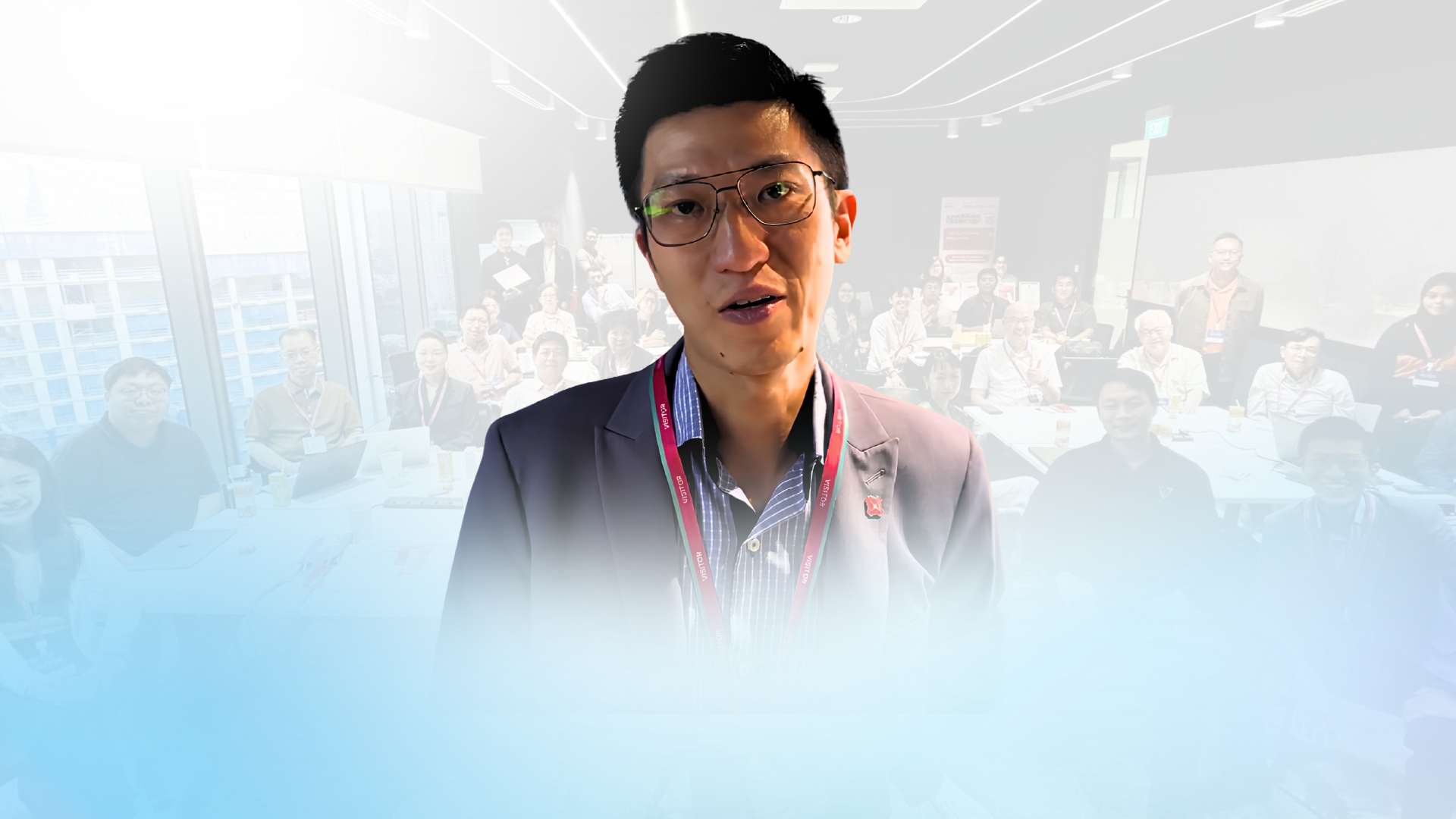

"It's very short, sweet, and interactive. You get hands-on and get to play with it, not just listen," says Daniel Li, who works in DBS's SME banking team, after sitting through a session of the AI Success Workshop's Align stage. He added that it showed on the participants' faces too: people were visibly enjoying the process.
Watch on YouTube ↗In a video interview after a recent AI Success Workshop session, Daniel Li, who works in DBS's SME banking team, offered a line that has stayed with us since: "If you're not on board with this AI wave, you might lose out in the long run."
It wasn't delivered as a warning about missing the newest tool. Daniel Li spends his days helping SME clients think through financing decisions, not selling AI software, and his comment carried the weight of someone who watches which businesses are adapting and which are standing still. It was a comment about direction: about which organisations are already building the habit of using AI well, and which are still deciding whether to start.
In a video interview after a recent AI Success Workshop session, Daniel Li, who works in DBS's SME banking team, offered a line that has stayed with us since: "If you're not on board with this AI wave, you might lose out in the long run."
It wasn't delivered as a warning about missing the newest tool. Daniel Li spends his days helping SME clients think through financing decisions, not selling AI software, and his comment carried the weight of someone who watches which businesses are adapting and which are standing still. It was a comment about direction: about which organisations are already building the habit of using AI well, and which are still deciding whether to start.
That distinction matters more than it sounds. Most executive conversations about AI adoption are still framed as a technology decision: which platform, which vendor, which use case first. Fewer are framed as a capability decision: whether the organisation is building the muscle to identify, prioritise and act on AI opportunities as they appear, month after month.
That distinction matters more than it sounds. Most executive conversations about AI adoption are still framed as a technology decision: which platform, which vendor, which use case first. Fewer are framed as a capability decision: whether the organisation is building the muscle to identify, prioritise and act on AI opportunities as they appear, month after month.
The gap between those two framings is where the real competitive risk sits, and it is widening faster than most leadership teams have registered. It isn't visible in a single quarter's numbers. It shows up three years later, in results that are hard to trace back to a decision made, or avoided, today.
The gap between those two framings is where the real competitive risk sits, and it is widening faster than most leadership teams have registered. It isn't visible in a single quarter's numbers. It shows up three years later, in results that are hard to trace back to a decision made, or avoided, today.
New research from Boston Consulting Group, published in July 2026, puts a number on that gap. Among 600+ large public companies with market capitalisation above US$5 billion, AI leaders delivered three-year shareholder returns 9.3 percentage points above the median; laggards sat 1.7 points below it. The more striking finding is the curve's shape, not its size: the jump from "active" adopters to leaders was a step change, not a straight line, and revenue per employee at leaders now grows four points faster than at laggards, year over year.
That curve suggests advantage in AI doesn't accumulate evenly. It sits flat while organisations experiment, then breaks upward sharply once the habit of prioritising and executing takes hold. Reading that curve from its flat part, a business could reasonably conclude it hasn't missed much yet, correctly today, and incorrectly in twelve months.
This is large-cap data; most Vision Academy readers run smaller organisations, but the mechanism doesn't depend on company size. Capability compounds the way interest does: a small, consistent advantage this quarter becomes structural three years from now, and the businesses ahead of that curve got there by starting earlier, not by picking a better tool.
Delay rarely looks like avoidance from the inside. It looks like diligence. Three signs tend to show up in organisations that haven't started: experimenting with a few tools without settling on which to commit to, no clear priorities, so every idea gets equal and usually no attention, and no consistent results, because nothing has been tracked long enough to know what's working.
Each surfaces quietly in a leadership meeting: the tool question gets raised, the business case doesn't exist because nothing's been tried, and the item rolls to next quarter with everyone agreeing it was sensible. Repeated four times a year, that sensible call is how an organisation quietly opts out of building a capability while its competitors build it in public.
This is the reframe Daniel Li's comment points to. The risk was never that a business picks the wrong AI tool. Most tools available today can be swapped out with relatively little cost. The risk is spending another quarter without the internal habit of scoring opportunities, testing the highest-value one, and learning from what happens. That habit is what Vision Academy calls AI capability, and it is what compounds. Tool choice doesn't.
This is the reframe Daniel Li's comment points to. The risk was never that a business picks the wrong AI tool. Most tools available today can be swapped out with relatively little cost. The risk is spending another quarter without the internal habit of scoring opportunities, testing the highest-value one, and learning from what happens. That habit is what Vision Academy calls AI capability, and it is what compounds. Tool choice doesn't.
Organisations further along this journey follow a similar shape: align on where AI pays back first, adopt one use case properly before adding a second, then accelerate into a system that keeps finding the next opportunity. Adopt and Accelerate only work once Align has done its job. Skip that step and you land in the 95% that MIT Sloan Management Review, 2025 found show no measurable impact on profit and loss, not the 5% that create scalable, repeatable results.
Organisations further along this journey follow a similar shape: align on where AI pays back first, adopt one use case properly before adding a second, then accelerate into a system that keeps finding the next opportunity. Adopt and Accelerate only work once Align has done its job. Skip that step and you land in the 95% that MIT Sloan Management Review, 2025 found show no measurable impact on profit and loss, not the 5% that create scalable, repeatable results.
The first stage, Align, is also the one most organisations skip, because it's the least visible. Its own goal is stated plainly: move from random usage to scored, prioritised opportunities. It doesn't produce a demo. It produces a ranked list, which is precisely why it matters.
The first stage, Align, is also the one most organisations skip, because it's the least visible. Its own goal is stated plainly: move from random usage to scored, prioritised opportunities. It doesn't produce a demo. It produces a ranked list, which is precisely why it matters.
Prioritise what matters, then move. Vision Academy runs this stage as the Align stage of the AI Success Workshop, delivered in Singapore as the Vision x SUTD 2-Day AI Course, with new cohorts opening monthly. The next intake runs 1–2 October 2026.
Prioritise what matters, then move. Vision Academy runs this stage as the Align stage of the AI Success Workshop, delivered in Singapore as the Vision x SUTD 2-Day AI Course, with new cohorts opening monthly. The next intake runs 1–2 October 2026.
|
|
Participant Perspective “It’s very short, sweet, and interactive. You get hands-on and get to play with it, not just listen.” It showed on the participants’ faces — people visibly enjoying the process. Daniel Li Session Participant, Align Workshop |
The implication: Align doesn't ask for a lengthy commitment before it starts paying attention. It asks for two days, and a willingness to score what's already in front of you.
The implication: Align doesn't ask for a lengthy commitment before it starts paying attention. It asks for two days, and a willingness to score what's already in front of you.
None of these require a vendor, a budget approval, or Vision Academy. They require an afternoon and a shortlist.
None of these require a vendor, a budget approval, or Vision Academy. They require an afternoon and a shortlist.
Do this once, and the point Daniel Li was making becomes concrete: the organisations pulling ahead aren't smarter about AI. They're further along a habit that started earlier.
Do this once, and the point Daniel Li was making becomes concrete: the organisations pulling ahead aren't smarter about AI. They're further along a habit that started earlier.
The 95% of AI projects that fail rarely fail because the technology didn't work. They fail because no one built the habit of prioritising, testing, and learning before scaling. Align is how an organisation joins the 5% that do, not by working harder, but by prioritising before it builds. The organisations that wait for certainty will get it eventually, by watching the competitors who didn't.
The 95% of AI projects that fail rarely fail because the technology didn't work. They fail because no one built the habit of prioritising, testing, and learning before scaling. Align is how an organisation joins the 5% that do, not by working harder, but by prioritising before it builds. The organisations that wait for certainty will get it eventually, by watching the competitors who didn't.
The future belongs to organisations that start learning before they're forced to catch up.
Copyright © 2026 Vision Academy. All rights reserved.